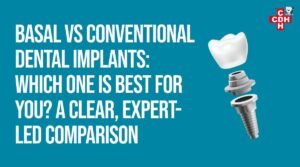

Basal vs Conventional Dental Implants which option is right for restoring missing teeth? These two implant systems follow different biomechanical principles and are designed for different patient profiles. Basal implants anchor into dense cortical bone and support immediate loading, making them suitable for individuals with severe bone loss, chronic periodontal disease, or cases that require time-sensitive full-mouth rehabilitation. Conventional implants rely on integration with the alveolar bone and follow a staged healing process.
Conventional implants integrate into the alveolar bone through osseointegration, offering a versatile and highly aesthetic solution, especially for single-tooth replacement or cases with healthy bone volume.
The core difference lies in bone requirement, healing time, and prosthetic flexibility. Basal implants eliminate the need for bone grafting and allow fixed teeth within 72 hours, while conventional implants follow a staged 3–6 month healing protocol and often require grafting procedures to build adequate support. Both systems deliver long-term success when used appropriately, but their suitability depends on clinical condition, medical history, and treatment goals.
Below is a quick comparison snapshot:
| Factor | Basal Implants | Conventional Implants |
| Healing | Immediate loading | 3–6 months |
| Bone Need | Minimal | Moderate |
| Best For | Bone loss, full-mouth cases | Single/multiple teeth |
Author Credentials
City Dental Hospital is powered by a team of 25+ expert doctors with a collective clinical experience of 125+ years. Their multidisciplinary skills encompass implantology, oral surgery, orthodontics, periodontics, prosthodontics, and digital dentistry, enabling comprehensive implant care that ranges from advanced full-mouth rehabilitation to refined aesthetic single-tooth restorations.
Definitions: Basal Implants vs Conventional Implants
What are Basal Implants
Basal implants are special implants designed to anchor into the strong cortical bone found deeper in the jaw. This bone remains stable even when a patient has severe bone loss, gum disease, or long-term missing teeth.
Key points:
- Use a strong basal bone for support
- Usually one-piece design (implant + abutment together)
- Allow immediate loading (fixed teeth in 48–72 hours)
- Do not need bone grafts or sinus lifts
- Works well for smokers, diabetics, and patients with low bone volume
Basal implants are commonly chosen for full-mouth rehabilitation or complex cases where conventional implants may fail.
What are Conventional Implants
Conventional (root-form) implants are the standard two-piece titanium implants placed in the alveolar bone, the upper portion of the jaw that holds natural teeth. They rely on osseointegration, meaning the implant fuses with the bone over 3–6 months.
Key points:
- Two-piece system (implant + abutment)
- Best for single teeth, small gaps, and aesthetic zones
- Healing time: 3–6 months before final teeth
- Often requires bone grafting or sinus lift if the bone is thin
- Excellent esthetics and prosthetic flexibility
Conventional implants are ideal when the bone is healthy, and the patient prefers a traditional, step-by-step treatment approach.
Step-by-Step Surgical Procedure
Basal Implant Procedure (Immediate-Loading Approach)
Clinical Evaluation & CBCT Scan
The dentist assesses bone quality and identifies strong cortical areas for support.
Extraction (if required)
Damaged or infected teeth are removed in the same appointment.
Implant Placement
Basal implants are inserted into the dense cortical bone using a minimally invasive technique. Their one-piece design reduces surgical steps.
Bite Adjustment & Framework Planning
Measurements are taken immediately to plan the temporary fixed teeth.
Immediate Loading (48–72 hours)
A fixed temporary bridge is attached, allowing patients to eat soft foods right away.
Final Prosthesis
After the soft tissues stabilize, the final fixed teeth are designed for long-term function.
Conventional Implant Procedure (Staged Healing Approach)
Clinical Examination & CBCT Scan
The dentist evaluates bone height and width to plan implant positioning.
Extraction & Site Preparation
If bone is insufficient, grafting or sinus lift procedures may be performed.
Implant Placement
The titanium implant is placed into the alveolar bone using a two-piece system.
Osseointegration (3–6 months)
The implant fuses with the bone during this healing phase. No chewing pressure is applied.
Abutment Placement
Once integrated, an abutment is attached to support the crown.
Final Crown or Bridge
A custom-made crown or bridge is fitted, matched to natural tooth color and bite alignment.
Evidence-Based Comparison
Clinical studies consistently show that both basal and conventional implants deliver strong long-term outcomes when used in the right clinical situations. The key differences come from biomechanics, bone requirements, and healing protocols.
Basal implants gain stability from dense cortical bone, while conventional implants depend on osseointegration within alveolar bone. The table below summarizes the most important evidence-based distinctions that influence success, durability, and treatment planning.
| Parameter | Basal Implants | Conventional Implants |
| Success Rate | 90–95% in compromised bone conditions | 94–98% in ideal bone |
| Loading Time | Immediate (48–72 hours) | Delayed (3–6 months) |
| Bone Requirement | Minimal; ideal for bone loss | Requires adequate height/width |
| Need for Bone Graft | Rare | Common in thin or low bone |
| Best Use Cases | Full-mouth rehab, smokers, diabetics, failed implant cases | Single tooth, small gaps, aesthetic zones |
| Prosthetic Flexibility | Moderate (one-piece design) | High (two-piece system) |
| Surgical Invasiveness | Low; fewer steps | Moderate; may require grafting |
These clinical differences make basal implants a strong option for patients with compromised bone or urgent timelines, while conventional implants remain the gold standard for single-tooth esthetics and cases with good bone foundation.
Candidacy Matrix
Choosing between basal and conventional implants depends on bone quality, medical history, treatment goals, and how quickly the patient wants fixed teeth. The following matrix simplifies how each system aligns with different clinical conditions.
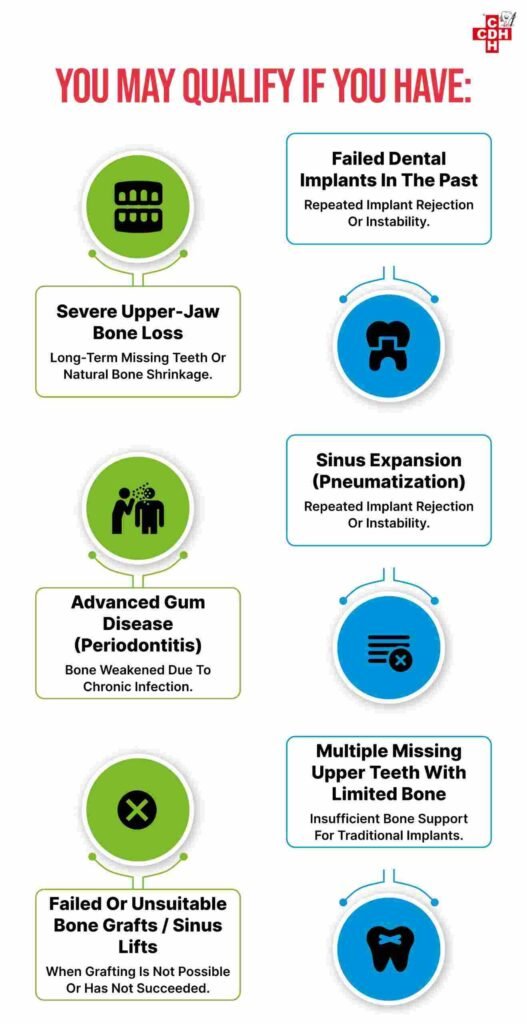
Ideal Candidates for Basal Implants
- Severe Bone Loss: Patients with thin ridges or advanced periodontal damage.
- Failed Implants or Grafts: Suitable when previous conventional implants or bone grafts have not succeeded.
- Chronic Smokers: Basal implants tolerate compromised healing environments better.
- Diabetic or Medically Compromised Patients: Beneficial due to reduced surgical steps and faster stabilization.
- Full-Mouth Rehabilitation Needs: Especially when immediate fixed teeth within 72 hours are desired.
- Long-Term Denture Wearers: Works well even when the alveolar bone is significantly resorbed.
Ideal Candidates for Conventional Implants
- Good Bone Volume: Patients with healthy alveolar bone in height and width.
- Single or Multiple Tooth Replacement: Especially in the front teeth, where esthetics matter most.
- Younger Patients: Suitable for stable, long-term biomechanical performance.
- Those Preferring a Traditional Approach: Step-by-step healing, shaping, and customization.
- High Aesthetic Demand: The two-piece design allows better angulation and gum contour control.
- Patients Willing to Wait: Ideal when a longer healing phase is acceptable for optimal results.
This matrix helps match the right implant system to both clinical and lifestyle factors.
Risks & Limitations
Both basal and conventional implants are safe and successful, but each has its own considerations. Understanding them helps set the right expectations.
Basal Implants
- Precise placement is essential because they anchor into deep cortical bone.
- Their one-piece design cannot be adjusted once placed, so the planning has to be accurate.
- Some patients may feel temporary pressure or soreness as the immediate fixed teeth begin functioning within 48–72 hours.
- They may not be ideal for very small, single-tooth gaps where angulation flexibility is needed.
Conventional Implants
- They depend on osseointegration, so patients need enough healthy bone. If bone is limited, procedures like bone grafting or sinus lifts may be required.
- These extra steps increase treatment time and cost.
- Healing may be slower in smokers, diabetics, or patients with gum disease, which can affect success.
- The multi-step process means more visits before the final crown is placed.
Common Considerations for Both
- Consistent oral hygiene and follow-up visits are necessary.
- Avoiding habits like teeth grinding, smoking, or chewing hard foods supports long-term success.
- With proper care and correct case selection, both systems show strong clinical outcomes.
Cost Breakdown (India vs USA, UK, Australia)
Dental implant cost in India is significantly lower than Western countries while maintaining world-class clinical standards, on full-mouth implant treatments without compromising on technology, materials, or expertise.
Average Cost Comparison Table
| Country | Basal Implants (Per Implant) | Conventional Implants (Per Implant) | Full-Mouth Rehabilitation (Basal) | Full-Mouth Rehabilitation (Conventional) |
| India | ₹25,000 – ₹45,000 | ₹30,000 – ₹60,000 | ₹2.5L – ₹4L | ₹4L – ₹8L |
| USA | ₹1,20,000 – ₹2,50,000 | ₹2,00,000 – ₹4,00,000 | ₹12L – ₹22L | ₹18L – ₹35L+ |
| UK | ₹1,00,000 – ₹2,20,000 | ₹1,80,000 – ₹3,50,000 | ₹10L – ₹18L | ₹15L – ₹30L |
| Australia | ₹1,10,000 – ₹2,40,000 | ₹1,90,000 – ₹3,80,000 | ₹11L – ₹20L | ₹16L – ₹32L |
Why India Is the Best Value for Implants
India offers 70–85% lower treatment costs than the USA, UK, and Australia, without compromising on implant brands, sterilization standards, or prosthetic quality. The difference arises mainly due to:
- Lower operational and lab costs
- High-volume implant centers with specialized expertise
- Affordable prosthetic materials without middle-layer pricing
- Faster turnaround due to in-house CAD/CAM facilities
This makes India one of the world’s most preferred destinations for full-mouth implant rehabilitation, especially for patients who need basal implants, immediate loading, or complex bone-loss solutions.
Why City Dental Hospital Is Perfect for Dental Tourism
City Dental Hospital becomes a standout option for international patients because:
- Expertise in basal and conventional implantology
- Ability to complete full-mouth implants in 72 hours
- Experienced surgeons with international training
- NABH-accredited facility ensuring world-class safety, hygiene, and clinical standards
- Advanced infrastructure: CBCT, CAD/CAM, digital planning
- Transparent pricing with no hidden charges
- Dedicated dental tourism assistance (travel support, accommodation guidance)
International patients in Dental Tourism in India save up to ₹10–20 lakhs on full-mouth treatment while receiving globally comparable care.
Case Studies
Full-Mouth Basal Implant Rehabilitation
A 62-year-old patient from the UK arrived with severe bone loss, mobile teeth, and difficulty chewing. Conventional implants were not possible without extensive grafting. Basal implants were placed in the strong cortical bone, and fixed teeth were delivered within 72 hours. The patient returned home in one week with a fully restored smile and normal chewing ability—saving nearly 70% compared to UK treatment costs.
Single-Tooth Conventional Implant (Aesthetic Zone)
A 28-year-old patient from Australia had a fractured upper front tooth. A conventional two-piece implant was placed after extraction, followed by a 3-month healing phase. A ceramic crown was designed to match the surrounding teeth. The final outcome delivered natural esthetics and stability.
Failed Implant Replacement
A US patient visiting India presented with a failed conventional implant placed abroad. Due to bone loss around the site, a basal implant was chosen. The new implant achieved immediate stability, allowing a fixed bridge in 48 hours.
Conclusion & Decision Path
Basal and conventional implants each offer reliable, long-lasting solutions, but the ideal choice depends on bone condition, treatment goals, medical history, and how quickly the patient needs fixed teeth. Basal implants excel for severe bone loss, full-mouth cases, and patients seeking immediate results. Conventional implants remain the preferred option for single-tooth replacements, high-aesthetic zones, and situations where step-by-step shaping is important. With proper planning and care, both systems deliver strong functional and aesthetic outcomes.
Decision Tree: Which Implant Is Right for You?
- Do you have significant bone loss?
→ Yes → Basal Implants
→ No → Move to next - Do you want fixed teeth within 72 hours?
→ Yes → Basal Implants
→ No → Conventional Implants - Is this a single front tooth or aesthetic zone?
→ Yes → Conventional Implants - Have previous implants failed?
→ Yes → Basal Implants
City Dental Hospital can evaluate each case and guide patients to the safest, most predictable solution.
FAQ — Top Patient Concerns
Q: Does getting implants hurt?
No, the implant surgery is done under local anesthesia. Most patients feel only pressure during placement; post-op discomfort typically lasts a few days and can be managed with standard pain relief.
Q: What are the biggest risks with implants?
Possible complications include infection at the implant site, gum recession, nerve irritation (rare), or failure to integrate with bone. Proper planning, skilled surgery, and hygiene reduce these risks significantly.
Q: Can people with bone loss or chronic conditions get basal implants?
Yes, that’s one of the main benefits of basal implants. Because they anchor in dense cortical bone, basal implants work well even when alveolar bone volume is low or reduced with age.
Q: Is recovery faster with basal implants compared to conventional ones?
Yes, basal implants often allow fixed teeth within 48–72 hours, whereas conventional implants typically require 3–6 months of healing for full bone integration.
Q: Do implants last as long as natural teeth?
With good oral hygiene, regular check-ups, and healthy gums/bone, implants (both basal and conventional) can last many years — often decades.
Q: Which is better — basal or conventional?
There’s no universal “best.” Basal implants suit people with bone loss who need fast results or complex cases. Conventional implants suit those with good bone, prioritizing long-term flexibility, aesthetics, or single-tooth replacement. The decision depends on individual condition, health, and goals.
Q: Can I fly back home soon after treatment? (International patients)
Yes — for basal implants, patients typically receive fixed teeth in 72 hours and can fly within 5–7 days. For conventional implants, you can travel in 2–3 days after placement, with follow-ups done online.
Q: Is India safe for dental tourism?
India’s top implant centers follow global sterilization protocols, digital planning, and international material standards. Many clinics have dedicated teams for overseas patients and assist with travel, stay, and coordination for traveling to India for dental implants.