Dental cavities often start small and are easy to miss in the early stages. Traditional diagnosis usually depends on visual examination and dental X-rays, interpreted by a dentist’s experience.
While this approach works well, patients are increasingly curious about whether technology can help detect cavities earlier and more consistently.
This has led to growing interest in AI cavity detection, a technology that uses artificial intelligence to analyze dental images and highlight areas that may show early signs of decay.
Patients want to know how this works, how accurate it really is, and whether it can be trusted in real dental settings.
This article is for patients who want clear, factual answers. You will learn how AI-based cavity detection works, what current accuracy levels actually mean, where its limits are, and how dentists use it as a support tool rather than a replacement for clinical judgment.
By the end, you will be better prepared to discuss cavity detection methods confidently with your dentist.
Key Takeaway
- AI cavity detection uses artificial intelligence to analyze dental images, such as X-rays, and highlight areas that may show early signs of tooth decay.
- It is designed to support dentists by improving consistency and early detection, not to replace clinical examination or professional judgment.
- Accuracy levels vary depending on the system and image quality, which is why dentist review is always essential.
- AI-based detection can help identify cavities at an earlier stage, potentially reducing the risk of delayed treatment.
- Patients should view AI as an assistive tool and discuss with their dentist which cavity detection methods are most appropriate for their dental health.
What Is AI Cavity Detection
AI cavity detection is the use of artificial intelligence software to analyze dental images, most commonly dental X-rays, to identify areas that may indicate tooth decay. These systems are trained on thousands of annotated dental images, allowing them to recognize visual patterns associated with early and advanced cavities.
In practical terms, AI cavity detection works as a decision-support tool. The software scans an X-ray and highlights regions where changes in tooth structure suggest possible decay. A dentist then reviews these highlights alongside a clinical examination to confirm whether a cavity is present and decide on treatment.
Unlike manual interpretation alone, AI systems are designed to:
- Detect subtle changes that may be difficult to notice in early stages
- Apply the same evaluation criteria consistently across images
- Reduce the chance of cavities being overlooked due to human fatigue or subjectivity
It is important to understand that AI does not make a diagnosis on its own. The final diagnosis always depends on the dentist’s clinical judgment, patient history, and physical examination. AI cavity detection simply provides an additional layer of analysis to support more informed and confident decision-making.
How AI Detects Cavities Step by Step
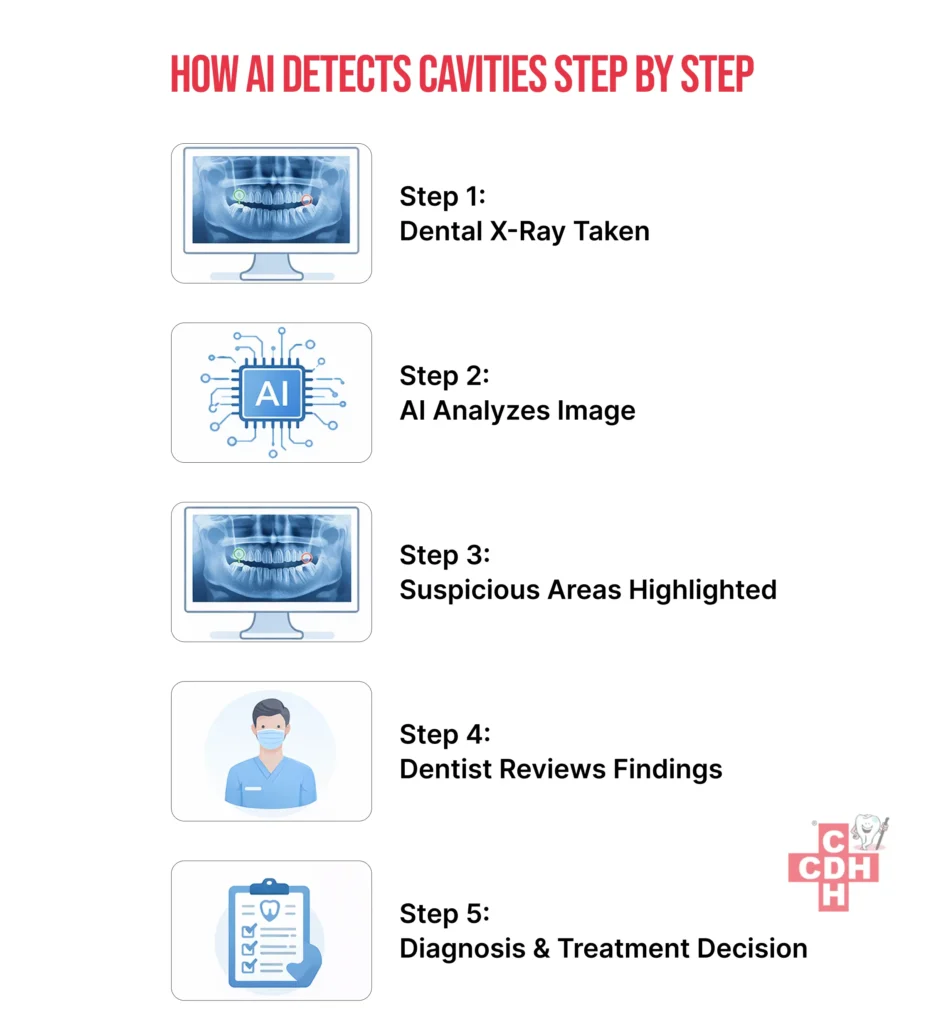
AI cavity detection follows a structured workflow that combines dental imaging, artificial intelligence analysis, and dentist verification. Each step plays a specific role in supporting accurate diagnosis.
Step 1: Dental images are taken
- The process starts with standard dental X-rays, such as bitewing or periapical X-rays.
- These are the same images used in routine dental examinations.
- Image quality is important because AI systems rely entirely on visual data.
Step 2: The AI system analyzes the image
- The X-ray is processed by AI software trained on large sets of labeled dental images.
- The system looks for visual patterns linked to tooth decay, such as:
- Changes in enamel or dentin density
- Shadowing between teeth
- Irregular structures near the tooth surface
- Changes in enamel or dentin density
- At this stage, the AI is identifying possible risk areas, not making a diagnosis.
Step 3: Areas of concern are highlighted
- The software marks regions where decay may be developing.
- These highlights help draw attention to early or subtle changes that can be easy to miss.
- The evaluation remains consistent across all images, reducing subjectivity.
Step 4: The dentist reviews and confirms
- The dentist reviews the AI highlights alongside:
- The original X-ray
- A clinical examination
- Patient symptoms and dental history
- Only a dentist can confirm whether a cavity is actually present.
Step 5: Diagnosis and treatment decisions are made
- If decay is confirmed, the dentist recommends treatment based on severity and location.
- If no cavity is confirmed, the area may be monitored during future visits.
- AI does not decide treatment. It supports more informed clinical decisions.
If decay is confirmed, the dentist may recommend tooth coloured filling for minor cavities or more advanced treatments if the damage is deeper.
How Accurate Is AI Cavity Detection
AI cavity detection is generally quite accurate, especially when it is used as a support tool alongside a dentist’s examination. It is not meant to work on its own, but to help dentists notice early signs of tooth decay more consistently.
In simple terms, AI works best when:
- Dental X-rays are clear
- The system is used by a trained dentist
- Findings are reviewed, not accepted automatically
Where AI performs well
- Identifying early or small cavities that may be difficult to see at first glance
- Highlighting areas between teeth where decay often starts
- Providing consistent analysis across different X-rays
Where AI has limitations
- It may sometimes flag areas that are not true cavities
- Very early surface decay may still be difficult to detect
- It cannot assess pain, sensitivity, or oral habits
This is why a dentist review is always essential.
What patients should know about accuracy?
Accuracy does not mean certainty. AI helps reduce missed cavities and supports better discussions between patients and dentists, but it does not replace professional judgment or clinical examination.
For patients, the real benefit is clarity and confidence, not automation.
AI Cavity Detection vs Traditional Diagnosis
Both AI cavity detection and traditional dental exams aim to find cavities early. The difference is how the information is analyzed, not who makes the final decision.
Traditional diagnosis
Dentists traditionally detect cavities by:
- Examining teeth visually
- Reviewing dental X-rays
- Considering pain, sensitivity, and dental history
This method is reliable and has been used for many years. However, very early cavities or small changes on X-rays can sometimes be hard to notice.
AI-assisted diagnosis
AI cavity detection uses software to analyze dental X-rays and highlight areas that may show early signs of decay.
It helps by:
- Pointing out subtle changes on X-rays
- Offering consistent image analysis
- Supporting early detection
The key thing patients should know
- AI does not replace the dentist
- The dentist always confirms the diagnosis
- AI is a support tool, not a decision-maker
What this means for you
The most accurate diagnosis comes from a dentist’s expertise, with technology used as support where appropriate. Understanding this helps you feel more confident about how cavities are detected and discussed.
Common Misconceptions About AI Cavity Detection
AI replaces the dentist
AI only highlights possible problem areas. The dentist always makes the final diagnosis.
AI is 100 percent accurate
AI helps improve detection, but it is not perfect and still needs dentist review.
An AI finding means treatment is required
Not every highlighted area needs treatment. Dentists assess severity and symptoms first.
AI can detect cavities without X-rays
AI works by analyzing dental images, usually X-rays. It cannot work on its own.
AI always increases treatment cost
Using AI does not automatically raise costs and may help prevent bigger problems later.
What Should Patients Take Away From AI Cavity Detection
AI cavity detection is not a replacement for dentists. It is a technology designed to support dental diagnosis by helping identify possible signs of decay on X-rays more consistently. Its real value lies in assisting early detection and improving clarity during diagnosis discussions.
For patients, what matters most is how decisions are made, not the technology alone. A dentist’s experience, clinical examination, and understanding of your dental history remain essential. Tools like AI, when used responsibly, simply add another layer of support.
If you are curious about different cavity detection methods and want to understand what approach is suitable for you, discussing this with a dental professional is the right next step.
If you would like clarity on cavity detection options and what is appropriate for your dental health, the team at City Dental Hospital can help guide you through your choices.
FAQs About AI Cavity Detection
Is AI cavity detection safe?
Yes. AI cavity detection analyzes dental images and does not directly interact with your teeth or body.
Is AI cavity detection accurate?
AI can be accurate when used as a support tool, but dentist review is always necessary.
Does AI replace the dentist?
No. Dentists always make the final diagnosis and treatment decisions.
Is AI used for every dental patient?
No. Its use depends on the clinic, the case, and the type of examination required.
Does AI cavity detection increase treatment costs?
Not always. Earlier detection may sometimes help prevent more complex treatments later.