Most people start clear aligners expecting quick, visible changes and then worry when nothing looks different in the first few weeks. This often leads to doubts about whether the treatment is actually working or worth the investment.
This guide is for patients worldwide whether in India or internationally who are considering clear aligners or already wearing them and want realistic answers, not marketing promises. Every aligner journey begins with a detailed intraoral scan, followed by a personalized digital treatment plan that maps how your teeth will move step by step. While this advanced planning makes treatment more predictable, visible results still take time to appear.
You’ll learn exactly when clear aligners usually start showing visible results, what changes happen before you can see them, and what timelines are normal for different cases. By the end, you’ll know what to expect and when to expect it, without confusion or false hope.
Key Takeaway
- Visible results from clear aligners usually begin in 3–6 weeks, even though tooth movement starts within the first few days
- Early changes are often noticed by the patient first, before they are obvious to others
- Mild alignment issues show visible improvement sooner than moderate or complex cases
- Full cosmetic correction takes several months, not weeks, even with a precise treatment plan
- Wear time, case complexity, and follow-up discipline affect results more than the aligner brand itself
- Accurate intraoral scans and treatment planning play a critical role in how smoothly and predictably results appear
- Knowing this timeline helps patients avoid unnecessary worry and set realistic expectations
How Long Do Clear Aligners Take to Show Results
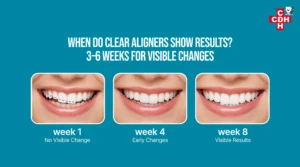
Most patients begin seeing visible changes from clear aligners in about 3 to 6 weeks. This does not mean teeth are idle before that. Tooth movement begins within the first few days, but those early shifts are too small to notice in the mirror.
A key reason for this delay is how treatment is designed. After your intraoral scan, your dentist creates a detailed treatment plan that moves teeth in small, controlled stages. Early stages often focus on preparing teeth for alignment rather than creating immediately visible changes.
Here’s the simple way to understand it:
- Weeks 1–2: Teeth are moving, but results are not visibly obvious
- Weeks 3–6: Early alignment changes become noticeable to you
- After 6–8 weeks: Changes are clearly visible, especially in mild to moderate cases
If you do not see changes in the first month, it usually means the treatment is progressing normally, not that it is failing. Visible results depend on how much correction your teeth need, not just how long you have been wearing aligners.
What Happens After You Start Wearing Clear Aligners
First 1–2 Weeks
During the first two weeks, teeth begin responding to controlled pressure from the aligners. This phase is about biological movement, not visible change.
- You may feel tightness or mild discomfort
- Teeth are loosening at a microscopic level
- No obvious visual difference yet
Not seeing changes here is normal and expected.
Weeks 3–6
This is when most patients start noticing early visible results.
- Small gaps reduce
- Crowded teeth begin straightening slightly
- Front teeth changes are usually noticed first
These changes are subtle but real. Many patients notice them when comparing photos or looking closely rather than at a glance.
2–3 Months
At this stage, visible improvement becomes clearer.
- Alignment looks more even
- Smile symmetry improves
- Friends or family may start noticing changes
For mild to moderate cases, this is when aligners feel clearly “worth it.”
Beyond 3 Months
This phase focuses on refinement and bite correction.
- Deeper alignment issues are addressed
- Progress may look slower but becomes more precise
- Final positioning takes time for long-term stability
This stage is heavily guided by the original treatment plan, which ensures teeth move safely and accurately.
What Affects How Fast Clear Aligners Show Results
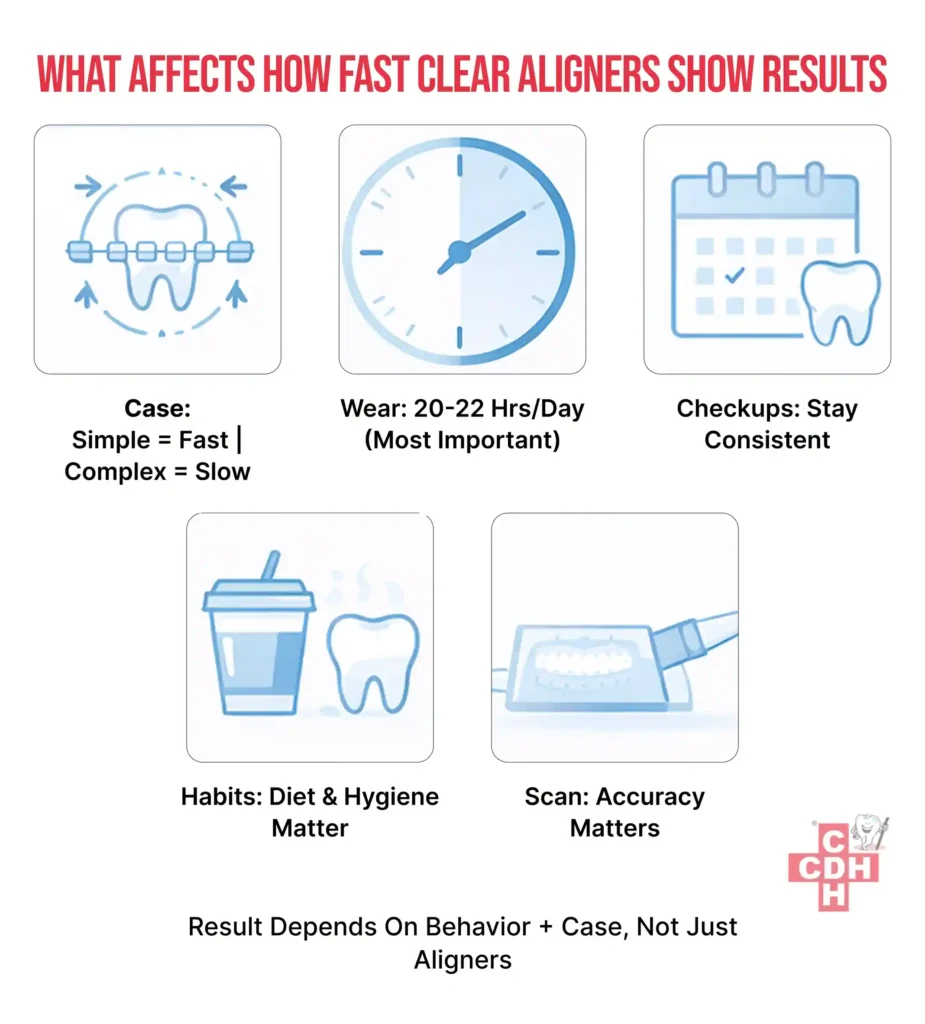
Clear aligners do not work at the same speed for everyone. Two patients can start on the same day and see results at very different times. This difference is usually caused by a few clear, predictable factors.
1. How complex your alignment problem is
- Mild crowding or spacing: visible changes appear sooner
- Moderate or severe issues: movement is slower but more controlled
More correction means more stages, which delays visible results.
2. How many hours per day you wear your aligners
Aligners must be worn 20–22 hours daily to stay on schedule.
- Wearing them less slows visible progress
- Skipping hours repeatedly delays results even if aligners fit well
Consistency matters more than speed.
3. How regularly you attend follow-up appointments
Follow-ups ensure your teeth are tracking correctly.
- Missed visits delay tray changes
- Small issues go uncorrected and slow visible improvement
Regular monitoring keeps timelines predictable.
4. Daily habits that commonly affect
This factor is often underestimated.
- Frequent tea, coffee, or snack breaks reduce wear time
- Removing aligners repeatedly adds up to lost hours
- Irregular routines slow visible changes
Small daily habits have a big impact over weeks.
Pro Tips on – Maintaining Aligners
5. Accuracy of Intraoral Scan and Treatment Plan
This is one of the most overlooked factors.
- High-quality intraoral scans create precise aligners
- A well-designed treatment plan ensures smoother movement
- Poor planning leads to delays, refinements, or extended timelines
What most people miss:
When aligner results feel slow, the cause is usually wear habits or case complexity, not failure of the treatment.
Realistic Examples Based on Common Cases
Mild alignment issues (small gaps or minor crowding)
People with minor alignment problems usually notice visible changes within 4–6 weeks.
- Front teeth begin lining up sooner
- Early changes are easier to spot in mirrors or photos
- Full correction is often completed faster than average
These cases often feel reassuring early in treatment.
Moderate alignment issues (visible spacing or crowding)
Moderate cases typically show visible improvement around 6–8 weeks.
- Tooth movement is steady but gradual
- Changes become noticeable before they look dramatic
- Smile improvement becomes clearer by the second or third month
Early progress may feel slow but is still on track.
Complex alignment or bite-related issues
Cases involving significant crowding, spacing, or bite correction may take 8–12 weeks or longer to show clear cosmetic changes.
- Early stages focus on preparing teeth for proper movement
- Visible improvement appears later in the treatment
- Progress may seem slow but follows a planned sequence
This timeline is expected for complex corrections.
Clear Aligners vs Braces: Visible Results Timeline
Clear Aligners
- Early changes are often noticed by the patient first
- Visible results usually appear within 3–6 weeks for mild cases
- Progress can feel slow at the beginning and faster later
- Requires high daily compliance to stay on track
Clear aligners tend to be more subtle in early stages, which can make progress feel less obvious even when movement is happening.
Braces
- Movement is often more visibly obvious earlier
- Changes may be noticeable within the first few weeks
- Work continuously without patient removal
- Aesthetic changes are easier to spot due to brackets and wires
Braces can look like they are working faster because the hardware makes movement more noticeable.
You Might Also Like – Braces Cost in India
What Matters More Than the Appliance
- Case complexity
- Treatment planning
- Consistency and follow-through
Both options can achieve similar results. The difference is mainly how and when progress becomes visible, not whether treatment is effective.
Common Misconceptions About Clear Aligner Results
Many concerns about clear aligners come from incorrect expectations rather than actual problems with treatment.
“If I don’t see changes in the first few weeks, it’s not working”
Tooth movement starts early, but visible changes take time. Not seeing results in the first month is normal, especially in moderate or complex cases.
“Clear aligners should show results faster because they are advanced”
Technology improves precision, not speed. Teeth still need time to move safely, regardless of how modern the system is.
“No pain means no progress”
Mild pressure or tightness often comes and goes. Lack of discomfort does not mean teeth are not moving.
“All aligner brands work at the same speed”
Results depend on treatment planning and monitoring, not just the brand name. Poor planning can slow visible progress.
“Wearing aligners longer hours will drastically speed things up”
Wearing aligners correctly keeps treatment on track. Overwearing does not shortcut biology and can cause discomfort.
FAQs About Clear Aligner Results
When do clear aligners start showing visible results?
Most people begin noticing visible changes between 3 and 6 weeks, even though tooth movement starts earlier.
Is it normal if I don’t see results in the first month?
Yes. Early changes are often too small to notice visually. This is normal and does not mean treatment is failing.
Do mild cases show results faster than complex cases?
Yes. Mild spacing or crowding usually shows visible improvement sooner than complex alignment or bite issues.
Can wearing aligners longer each day make results faster?
Wearing aligners for the recommended 20–22 hours per day keeps treatment on schedule. Wearing them longer does not safely speed up results.
What if I don’t see visible results after two months?
This can still be normal in complex cases. A follow-up check helps confirm that teeth are tracking correctly.
What to Do Next for Predictable Results
If you are considering clear aligners or already wearing them, the next step is to focus on predictable outcomes, not rushed timelines.
If you want reliable, visible progress:
- Get a detailed assessment with an intraoral scan
- Ask for a clear, step-by-step treatment plan when visible changes are expected
- Follow wear-time instructions consistently to avoid unnecessary delays
- Attend follow-up visits so progress stays on track
For international patients, planning becomes even more important. With a well-structured treatment plan and proper coordination City Dental Hospital supports dental tourism patients by clear aligner treatment can progress smoothly, transparent timelines, and cost-effective care.
Many patients choose to begin or continue aligner treatment while traveling, provided the planning is precise and follow-ups are well managed. With the right setup, visible results can progress smoothly even when treatment is part of a dental travel plan.